Gravity can bend the path of light.
Why this sounds fake
Light feels like the one thing that should always travel straight unless it hits glass or water.
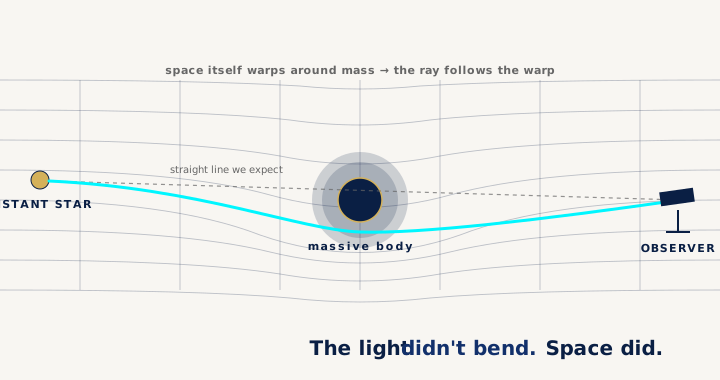
Light feels like the thing that travels in straight lines. Gravity changes that intuition. NASA explains gravitational lensing as the bending of light from distant objects by the gravity of massive objects between the source and the observer. The light is not hitting a glass lens; space itself is warped by mass, so the path light follows curves. This is how astronomers can use galaxies and galaxy clusters as natural lenses. The fact is strong because it breaks two everyday ideas at once: light is not simply straight, and gravity is not just something that pulls falling objects downward.
The cyan ray is one continuous beam — it curves because the grid behind it visibly sags around the mass.
1 discovery explored