A brainless slime mold can use its own slime trail as a memory.
Why this sounds fake
We treat memory as something stored in brains, not as a physical trail left behind by a single-celled organism.
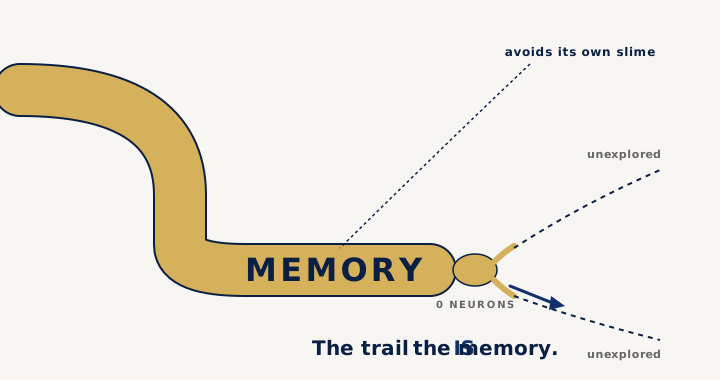
Memory sounds like something that belongs inside a nervous system. Physarum polycephalum has no brain and no neurons, but it leaves slime behind as it moves. In experiments, the organism tended to avoid areas already covered by its own extracellular slime, helping it navigate without rechecking the same space. Researchers described this as an externalized spatial memory. The slime is not a thought in the human sense. It is more surprising than that: the organism changes the world, then reads that change later as useful information. Memory does not have to live only inside a head.
Without a single neuron, the slime mold stores 'I've been here' as the trail it leaves outside its body.
1 discovery explored